
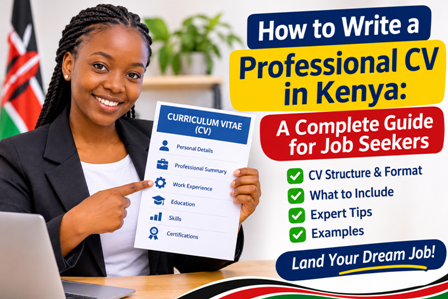
How to Write a Professional CV in Kenya: A Complete Guide for Job Seekers
Author: Stephen Magero
Published on: 20 November 2026
Last reviewed: 20 November 2026
Writing a professional curriculum vitae (CV) is an important step when applying for employment in Kenya. Employers use CVs to understand an applicant's education, professional background, practical experience, skills and suitability for an advertised position. A well-prepared CV helps communicate this information clearly and gives recruiters a useful basis for deciding whether to invite a candidate for an interview.
The Kenyan job market includes opportunities for school leavers, college and university graduates, experienced professionals, skilled workers and people changing careers. Although these applicants may have different qualifications and employment histories, they all need to present their backgrounds accurately and professionally.
A common challenge among job seekers is knowing what information to include, how to organise it and how to demonstrate suitability when they have limited work experience. Some applicants include too much personal information, use generic descriptions of their abilities or submit the same CV for every vacancy. Others overlook important details such as contact information, employment dates and the specific qualifications requested by an employer.
A professional CV should do more than list previous activities. It should help an employer understand what you can contribute, what you have learned and how your background relates to the position.
This guide explains how to write a professional CV in Kenya, the sections to include, formatting recommendations, common mistakes to avoid and practical examples for different career stages. Whether you are a recent graduate preparing your first CV, an experienced professional seeking a new opportunity or someone changing careers, the guidance will help you present your qualifications and experience more effectively.
The examples in this article are illustrative. They are not actual job advertisements, employer requirements, candidate testimonials or recruitment outcomes. Applicants should always follow the instructions provided in the vacancy they are applying for.
1. What Is a Curriculum Vitae (CV)?
A curriculum vitae, commonly called a CV, is a professional document that summarises an individual's education, work experience, skills, professional training and relevant achievements.
Its main purpose is to help an employer assess whether an applicant has the background required for a particular position.
A CV normally contains information such as:
- Full name and appropriate contact details.
- Professional summary or career profile.
- Employment history, where applicable.
- Academic qualifications.
- Technical and professional skills.
- Relevant certifications and training.
- Projects, internships or volunteer experience, where relevant.
- Professional memberships or other relevant information.
A CV is not an autobiography. It does not need to describe every activity you have undertaken since childhood. Instead, it should focus on information that helps an employer understand your suitability for the position.
What makes a CV professional?
A professional CV should have several important characteristics.
Clear organisation: Information should be arranged under recognisable headings so that employers can locate important details easily.
Job relevance: The information should relate to the position being advertised. Unrelated details should not distract from your qualifications.
Accuracy: Academic qualifications, employment dates, professional registrations and achievements should be truthful.
Readability: Use an appropriate font, consistent spacing and a simple layout.
Professional presentation: The document should be free from spelling mistakes, confusing formatting and unnecessary personal information.
A professional CV does not need complicated graphics or expensive templates. Its effectiveness depends primarily on the relevance, accuracy and presentation of its content.
2. Why a Professional CV Matters
A CV is often one of the first documents an employer reviews when considering an applicant. It helps the recruiter understand the candidate's background before deciding whether further assessment is appropriate.
When an organisation receives many applications, recruiters need to identify information relevant to the advertised position. A poorly organised CV can make it difficult to find important qualifications or experience, even when the applicant is suitable.
A well-written CV can help you:
- Present your academic qualifications clearly.
- Demonstrate relevant employment or practical experience.
- Highlight skills related to the advertised position.
- Explain your professional development.
- Show evidence of responsibilities and achievements.
- Communicate your suitability for an interview.
However, a good CV does not guarantee an interview or employment. Recruitment decisions depend on several factors, including the employer's requirements, the quality of applications received, interviews, assessments and other selection procedures.
Your objective should be to make it easy for the employer to understand your background and assess your suitability.
3. Understand the Basic Structure of a Professional CV
A professional CV should follow a logical structure. The order of sections may vary depending on your experience and the type of position you are applying for.
A typical CV in Kenya can include the following sections:
- Personal and contact information.
- Professional summary or career profile.
- Work experience.
- Academic qualifications.
- Skills and competencies.
- Professional training and certifications.
- Projects, internships or volunteer experience.
- Professional memberships, languages or other relevant information.
- Referees, if requested or appropriate.
You do not need to include every section if it does not apply to your background.
For example, a recent graduate may place education and practical training before employment history. An experienced professional may place work experience immediately after the professional summary.
The aim is to present the most relevant information early in the document.
4. How to Write the Personal Details Section
The personal details section normally appears at the top of the CV. It allows the employer to identify the applicant and obtain the appropriate contact information.
Include the following:
- Your full name.
- A reliable mobile phone number.
- A professional email address.
- Your town or city and country.
- A LinkedIn profile or professional portfolio, if relevant.
Example of a professional contact section
STEPHEN MAGERO
Mombasa, Kenya
Phone: 07XX XXX XXX
Email: stephen.magero@example.com
LinkedIn: linkedin.com/in/your-profile
This is an illustrative example. Replace the contact details with your own accurate information.
Personal information you should generally avoid
Unless the employer specifically requests information for a legitimate recruitment purpose, you generally do not need to include:
- National identification number.
- Passport number.
- Marital status.
- Religion.
- Tribe or ethnic background.
- Full residential address.
- Bank account details.
- Personal information unrelated to the position.
Do not send sensitive identification or financial information through an unverified recruitment channel. If an employer legitimately requires identity documents at a later recruitment stage, establish that the request is genuine and use an appropriate secure submission method.
Should you include a photograph?
A photograph is not generally necessary for an ordinary professional CV unless the employer specifically requests one or the nature of the role makes it relevant.
For most applications, prioritise clear contact information, qualifications, experience and skills rather than decorative elements.
5. How to Write a Professional Summary
The professional summary is a short introduction that appears near the beginning of your CV. It helps the employer understand your professional background and the strengths you bring to the position.
A good summary usually contains three or four concise sentences covering:
- Your profession or career area.
- Your level of experience or current career stage.
- Your most relevant qualifications or skills.
- The type of contribution you can make to the position.
Avoid generic statements that do not explain your actual abilities.
Example for an experienced professional
Professional Summary
An administrative professional with experience supporting office operations, document management and customer communication. Familiar with maintaining records, coordinating routine administrative activities and using common office applications. Demonstrates attention to detail, organisation and the ability to follow established procedures.
This example should only be used by applicants whose actual experience supports these statements.
Example for a fresh graduate
Professional Summary
A recent Diploma in Business Administration graduate with academic knowledge of office administration, business communication and record management. Familiar with Microsoft Word and Excel and interested in developing practical experience in an administrative environment. Organised, willing to learn and committed to carrying out assigned responsibilities accurately.
The summary should reflect your actual qualification and abilities. Do not claim professional experience, software expertise or achievements that you cannot demonstrate.
Common professional summary mistakes
Avoid:
- Writing a long personal biography.
- Using exaggerated descriptions such as "the best employee in Kenya."
- Including unsupported claims about professional expertise.
- Repeating the same information throughout the CV.
- Using a generic summary unrelated to the position.
A good professional summary is specific, honest and relevant.
6. How to Present Your Work Experience
The work experience section is particularly important for applicants who have previously held formal or informal employment positions.
It helps employers understand where you have worked, what responsibilities you handled and what you achieved.
List your employment history in reverse chronological order, beginning with your most recent position.
For each position, include:
- Job title.
- Employer or organisation.
- Employment period.
- Main responsibilities.
- Relevant achievements, where applicable.
Example of work experience
Administrative Assistant
ABC Business Services
January 2024 – October 2026
Responsibilities:
- Assisted with organising office records and maintaining document files.
- Prepared routine correspondence and internal office documents.
- Responded to general enquiries and directed visitors to the appropriate departments.
- Supported the organisation of meetings and office activities.
- Used Microsoft Word and Excel for routine administrative tasks.
Achievement:
- Helped organise digital and physical filing records to make routine document retrieval more consistent.
This is an illustrative example. Applicants should describe duties and achievements that they genuinely performed.
Focus on achievements rather than duties alone
A list of duties explains what you were assigned to do. Achievements provide more information about the contribution you made.
For example:
General statement:
Responsible for customer service.
More informative statement:
Responded to customer enquiries, provided product information and referred complex complaints to the appropriate department.
The second statement explains the actual activities involved.
Where reliable information is available, include measurable results. For example, an applicant may state the number of records processed or customers supported if those figures are accurate and can be explained.
Do not invent performance figures or claim responsibility for results that were achieved by an entire team.
What if you have no formal employment experience?
Lack of formal employment does not mean that you have nothing relevant to include.
You may have gained useful experience through:
- Industrial attachments.
- Internships.
- Volunteer activities.
- Academic projects.
- Practical training.
- Freelance assignments.
- Community activities.
- Family business responsibilities, where genuinely performed.
Present these activities accurately and identify the type of experience involved.
For example:
Industrial Attachment – Administration Department
ABC Organisation
May 2026 – August 2026
Responsibilities:
- Assisted with arranging and filing office documents.
- Supported basic data entry activities.
- Helped maintain organised administrative records.
- Observed routine office communication and documentation procedures.
This example demonstrates how a graduate can describe practical training without presenting it as full-time employment.
7. How to Write the Education Section
The education section provides information about your academic qualifications and the institutions where you studied.
It is especially important for students, recent graduates and applicants applying for positions with specific educational requirements.
Include:
- Qualification obtained or being pursued.
- Name of institution.
- Year of completion or expected completion.
- Relevant specialisation, where applicable.
Example of an education section
Diploma in Business Administration
Example College
Completed: 2025
Kenya Certificate of Secondary Education (KCSE)
Example Secondary School
Completed: 2022
These are illustrative details, not a statement about an actual applicant's qualifications.
Should you include KCSE results?
Include your KCSE qualification and grades when they are relevant to the vacancy or requested by the employer.
For example, some entry-level opportunities specify particular KCSE subject grades. In such cases, provide accurate information in the format requested.
For more senior professional positions, your highest relevant qualifications may be more important than detailed secondary-school results.
Should you include incomplete studies?
If you started a course but did not complete it, do not present it as a completed qualification.
You can describe it accurately by stating:
- The course or programme.
- The institution.
- The period attended.
- Your current status, such as "studies ongoing" or "coursework completed, qualification pending," where accurate.
Employers should be able to distinguish between completed qualifications and studies that are still in progress.
8. How to Include Skills and Competencies
The skills section helps employers identify abilities that relate to the advertised position.
Skills generally fall into two broad categories: technical skills and transferable or interpersonal skills.
Technical skills
Technical skills are practical abilities associated with specific tools, systems, processes or occupations.
Examples include:
- Microsoft Word.
- Microsoft Excel.
- Data entry.
- Bookkeeping.
- Database management.
- Computer troubleshooting.
- Graphic design.
- Customer relationship management systems.
- Financial reporting.
- Records management.
Only include tools and tasks that you can use or explain confidently.
Transferable and interpersonal skills
These are abilities that can be useful across different occupations and working environments.
Examples include:
- Communication.
- Teamwork.
- Time management.
- Problem-solving.
- Organisation.
- Customer service.
- Attention to detail.
- Adaptability.
Do not simply list as many skills as possible. Select those that are relevant to the vacancy and provide evidence of them through your education, experience or practical activities.
Example of a skills section
Technical Skills
- Microsoft Word: Preparing and formatting documents.
- Microsoft Excel: Basic spreadsheets and data entry.
- Records Management: Organising and maintaining documents.
- Email Communication: Sending and managing professional correspondence.
Transferable Skills
- Written and verbal communication.
- Team collaboration.
- Time management.
- Attention to detail.
- Problem-solving.
An applicant should adjust this list to reflect their actual abilities.
9. Include Relevant Certifications and Professional Training
Certifications and additional training can strengthen your CV by demonstrating that you have developed knowledge or practical skills beyond your main academic qualification.
Depending on your career field, relevant training may include:
- Computer applications.
- Accounting and bookkeeping.
- Project management.
- Occupational health and safety.
- Customer service.
- Digital marketing.
- Technical and vocational training.
- Professional development courses.
For each relevant certification, include:
- Name of the course or certification.
- Training institution or issuing organisation.
- Completion date.
- Certificate status, if still in progress.
Example
Certificate in Computer Applications
Example Training Centre
Completed: 2025
Introduction to Project Management
Example Online Training Provider
Completed: 2026
Use the correct name of the qualification and the organisation that issued it. Do not describe attendance at a short introductory course as a professional licence or accredited qualification unless that status is accurate.
For regulated occupations in Kenya, check whether the employer requires registration, licensing or membership with a relevant professional body.
10. How to Include Projects, Internships and Volunteer Experience
Projects and volunteer activities can demonstrate practical abilities, particularly for applicants who have limited employment experience.
The information should explain what the activity involved, your actual contribution and the skills you developed.
Academic projects
A student who completed a relevant academic project may include it when it demonstrates skills needed for the advertised position.
For example:
Academic Project: Business Records Management
- Participated in a project involving the organisation of sample business records.
- Applied basic record-classification and document-management concepts.
- Prepared a written report explaining the proposed filing procedure.
This example is illustrative. Do not claim to have completed a project that you did not undertake.
Volunteer experience
Volunteer work may demonstrate communication, organisation, teamwork and community involvement.
For example:
Volunteer – Community Activities
Example Community Organisation
March 2025 – June 2025
- Assisted with organising participant registration records.
- Supported communication with programme participants.
- Helped coordinate routine event activities.
Describe the organisation and your role accurately. If the activity was informal, do not give it a formal job title that suggests employment.
11. How to Tailor Your CV for Each Job Application
One of the most useful CV-writing practices is tailoring your document to the specific vacancy.
Employers do not necessarily look for the same qualifications, experience or skills in every position. A CV prepared for an administrative role may need different emphasis from one prepared for an accounting, IT or customer-service position.
Sending an identical CV to every employer can make it difficult to demonstrate how your background matches the particular vacancy.
Steps for tailoring your CV
Step 1: Read the vacancy carefully.
Identify the job title, responsibilities, academic qualifications, experience requirements and essential skills.
Step 2: Identify the relevant requirements.
Separate compulsory qualifications from desirable skills or additional experience.
Step 3: Review your own background.
Identify the qualifications, experience and abilities that genuinely match the requirements.
Step 4: Update your professional summary.
Highlight the experience or skills most relevant to the position.
Step 5: Reorganise relevant information.
Give greater prominence to the qualifications, projects or responsibilities that demonstrate your suitability.
Step 6: Use accurate job-related terminology.
Where appropriate, use terminology found in the vacancy description, provided it accurately describes your abilities.
Step 7: Proofread the final document.
Check that the correct employer, job title and contact details appear in your application.
Understanding Applicant Tracking Systems (ATS)
Some employers use applicant tracking systems to receive, organise and manage job applications. Depending on the system and employer's recruitment process, these tools may help with application management and searching for relevant information.
To make your CV easier for software and people to read:
- Use standard section headings.
- Keep the layout simple.
- Use selectable text rather than a scanned image.
- Avoid placing essential information only inside graphics.
- Use conventional bullet points.
- Follow the file-format instructions in the vacancy.
- Include relevant terminology naturally.
An ATS-friendly format does not guarantee that your application will be shortlisted. Employers may use different systems and screening procedures, and human reviewers remain important in many recruitment processes.
12. Professional CV Formatting and Presentation Tips
A professional CV should be easy to read on a computer or mobile device and should also print clearly.
The following recommendations can help you prepare a clean document.
Choose a readable font
Common professional fonts include:
- Arial.
- Calibri.
- Aptos.
- Times New Roman.
Use a consistent font throughout the document. A body-text size of approximately 10.5 to 12 points is generally readable, while headings can be slightly larger.
Use clear section headings
Use headings such as:
- Professional Summary.
- Work Experience.
- Education.
- Skills.
- Certifications.
- Projects.
This makes the document easier to navigate.
Keep formatting consistent
Use consistent:
- Heading styles.
- Date formats.
- Bullet points.
- Line spacing.
- Margins.
- Alignment.
Avoid unnecessary changes in font size, colour or text alignment.
How long should a CV be?
CV length depends on the applicant's experience, qualifications and the type of position.
For many students and early-career applicants, one or two pages are sufficient. Experienced professionals with substantial relevant employment history, specialist qualifications or publications may reasonably need more space.
Do not remove important relevant information merely to meet an arbitrary page limit. Equally, avoid adding unrelated information simply to make the document longer.
Save your CV in the correct format
PDF is commonly used because it helps preserve the document's layout across different devices.
However, some employers specifically request Microsoft Word documents or applications through an online form.
Always follow the vacancy instructions rather than assuming one file format is suitable for every employer.
Use a professional file name, such as:
Stephen_Magero_CV.pdf
Avoid file names such as:
mynewcvfinal2.pdf
13. Common CV Mistakes to Avoid
A CV can contain relevant qualifications and experience but still appear unprofessional because of avoidable errors.
Review the following common mistakes before submitting your application.
1. Spelling and grammar errors
Incorrect spelling and unclear sentences can make the document difficult to understand. Use a spellchecker and proofread the final version.
2. Using an unprofessional email address
Create an email address that uses your name or a suitable professional variation. Avoid nicknames or phrases that may appear inappropriate in a recruitment setting.
3. Including irrelevant personal information
Focus on information relevant to the job. Unnecessary personal details can make the CV longer without improving the employer's understanding of your suitability.
4. Sending the same CV to every employer
Different vacancies have different requirements. Review and adjust your CV before submitting each application.
5. Exaggerating qualifications or experience
Never invent a degree, professional certificate, employment position, reference or achievement. Employers may request supporting documents or verify information.
6. Using long and complicated paragraphs
Use concise sentences and bullet points to make responsibilities and achievements easier to understand.
7. Providing outdated contact information
Check your telephone number and email address. An employer may be unable to contact you if these details are incorrect.
8. Using excessive graphics and decorations
Unnecessary colours, icons, tables and complicated layouts can distract from important information and may affect how some recruitment systems process the document.
9. Including unverified referees
Do not list someone as a referee without their permission. Confirm that their contact details are accurate and that they are willing to provide a professional reference.
10. Failing to follow application instructions
Some employers require a particular subject line, application form, document format or reference number. Follow the instructions provided in the advertisement.
14. How to Prepare a CV for Different Career Stages
A professional CV should reflect the applicant's actual career stage. A recent graduate and a professional with ten years of experience should not necessarily use the same section order or emphasis.
CV for a recent graduate
A recent graduate should give appropriate attention to education, industrial attachment, internships, relevant projects and practical skills.
A suitable section order may be:
- Contact information.
- Professional summary.
- Education.
- Industrial attachment or internship.
- Projects and volunteer experience.
- Skills.
- Relevant training.
- Referees, if requested.
The applicant should not create artificial work experience simply to make the CV look longer.
CV for an experienced professional
An experienced professional should highlight relevant employment history, responsibilities, achievements and career progression.
A suitable section order may be:
- Contact information.
- Professional summary.
- Work experience.
- Key skills.
- Education.
- Certifications and professional memberships.
- Relevant projects.
- Referees, if requested.
Older or unrelated employment can be shortened where it does not contribute meaningfully to the application.
CV for someone changing careers
A career changer should emphasise transferable skills, relevant training, practical projects and experience that connects to the new occupation.
For example, someone moving from customer service into administrative work may highlight genuine experience in record keeping, customer communication, handling enquiries and organising information.
The applicant should explain the connection between previous experience and the new role without suggesting that they have professional experience they do not possess.
15. Practical CV Example for a Job Seeker in Kenya
The following simplified example demonstrates how a recent graduate might organise a CV when applying for an entry-level administrative position.
It is a fictional example. The name, contact details, institution and experience are illustrative and should not be copied as factual information.
MARY WANJIKU
Nairobi, Kenya
Phone: 07XX XXX XXX
Email: mary.wanjiku@example.com
PROFESSIONAL SUMMARY
A recent Diploma in Business Administration graduate with academic knowledge of office administration, business communication and records management. Familiar with Microsoft Word and Excel and interested in developing practical experience in an administrative support role. Organised, attentive to detail and willing to learn.
EDUCATION
Diploma in Business Administration
Example College
Completed: 2025
Kenya Certificate of Secondary Education
Example Secondary School
Completed: 2022
INDUSTRIAL ATTACHMENT
Administrative Department – Example Organisation
May 2025 – August 2025
- Assisted with organising and filing office documents.
- Supported routine data entry activities.
- Helped maintain administrative records.
- Assisted with preparing and arranging documents for office use.
- Observed established office communication and filing procedures.
SKILLS
- Microsoft Word.
- Basic Microsoft Excel.
- Document organisation.
- Records management.
- Written communication.
- Teamwork.
- Time management.
ADDITIONAL TRAINING
Certificate in Basic Computer Applications
Example Training Centre
Completed: 2024
REFEREES
Available upon request, or provide the referees' details if the employer specifically requests them.
This example illustrates a simple structure for an entry-level applicant. A real applicant should include only qualifications, skills and activities that can be supported by their actual background.
16. How to Review Your CV Before Submitting It
Before sending a CV to an employer, take time to review the entire document.
A final review can help identify missing information, inconsistencies and formatting problems.
Check the following:
Contact details
- Is your name correctly written?
- Is your telephone number current?
- Is your email address professional?
- Does your location accurately reflect where you are based?
Professional summary
- Does it describe your actual background?
- Is it relevant to the advertised position?
- Does it avoid unsupported claims?
Employment and education
- Are employment dates accurate?
- Are job titles and institution names correct?
- Are completed and ongoing qualifications clearly distinguished?
- Are responsibilities and achievements truthful?
Skills and certifications
- Are the skills relevant to the vacancy?
- Can you explain or demonstrate the abilities listed?
- Are certification names and issuing organisations accurate?
Presentation
- Are the headings consistent?
- Is the document easy to read?
- Are there spelling or grammar mistakes?
- Is the file saved in the format requested by the employer?
Application instructions
- Have you used the correct file name?
- Have you included all requested supporting documents?
- Have you followed the employer's submission procedure?
- Have you checked the closing date?
A final review is particularly important when submitting several applications because an old employer name, job title or contact detail can accidentally remain in a revised CV.
17. Frequently Asked Questions About Writing a CV in Kenya
1. How do I write a professional CV in Kenya?
Start with your contact details, professional summary, work experience, education and relevant skills. Include certifications and other sections where they strengthen your application. Use a clear format, provide accurate information and tailor the CV to each vacancy.
2. How many pages should a CV have?
Many students and early-career applicants can present their relevant information in one or two pages. Experienced professionals may need additional pages when they have substantial relevant experience, specialist qualifications or other important information to include.
3. Should I include a photograph in my CV?
A photograph is generally unnecessary unless the employer specifically requests it or it is relevant to the nature of the position. Follow the instructions in the vacancy advertisement.
4. Should I include my national ID number?
A national ID number is generally not necessary on an ordinary CV. Do not include sensitive identification details unless there is a legitimate requirement, and use an appropriate secure channel when documents are requested.
5. Can I write a CV without work experience?
Yes. Recent graduates and applicants without formal employment can include education, industrial attachments, internships, practical training, academic projects, volunteer activities and relevant skills.
6. What should a fresh graduate include in a CV?
A fresh graduate should include contact information, a professional summary, academic qualifications, industrial attachment or internship experience, relevant projects, practical skills and certifications where applicable.
7. Should I include referees in my CV?
Follow the employer's instructions. You may include referees when requested, or state that they are available upon request where appropriate. Always obtain permission before sharing someone's contact details.
8. Is a PDF or Word document better for a CV?
PDF is commonly used to preserve formatting, but some employers request Word documents or applications through a recruitment portal. Use the file format specified in the vacancy advertisement.
9. What is an ATS-friendly CV?
An ATS-friendly CV uses a clear, readable structure that can be processed by common recruitment software. Standard headings, selectable text and a simple layout can help. However, different systems work differently, and no particular format guarantees selection.
10. Should I use the same CV for every job?
It is better to tailor your CV to each position. Highlight the qualifications, experience and skills that are relevant to the specific vacancy while keeping all information accurate.
11. Should I include my KCSE grades?
Include your KCSE results when they are relevant to the vacancy or specifically requested by the employer. Follow the employer's instructions about which subjects and grades to provide.
12. Can I include online courses in my CV?
Yes, where the courses are relevant to the position. State the correct course name, training provider and completion status. Do not present an introductory online course as a formal professional qualification unless that description is accurate.
13. How often should I update my CV?
Review your CV whenever you gain a new qualification, complete relevant training, acquire practical experience or achieve a professional milestone. You should also tailor it before submitting a new application.
14. Where can I find job opportunities in Kenya?
Job seekers can explore employer career websites, official government recruitment portals, professional networks and online employment platforms such as JobOoro. Always review the vacancy details and verify important recruitment information before applying.
Conclusion: Build a Professional CV That Clearly Presents Your Value
A professional CV is an important part of the job application process. It gives employers an organised overview of your education, employment history, practical experience and relevant abilities.
Writing an effective CV does not require complicated language or elaborate designs. It requires accurate information, clear organisation, relevant examples and attention to the requirements of the position.
Whether you are a recent graduate, an experienced professional or someone changing careers, focus on presenting your actual background in a way that helps employers understand your suitability.
Before submitting your next application:
- Prepare clear and accurate contact information.
- Write a professional summary relevant to the vacancy.
- Present your education and experience honestly.
- Highlight skills that you can demonstrate.
- Include relevant training and practical projects.
- Use a readable and consistent format.
- Tailor your CV to the advertised position.
- Proofread the final document.
- Follow the employer's application instructions.
A carefully prepared CV cannot guarantee employment, but it can help you communicate your qualifications more effectively and present a professional application.
Visit JobOoro to explore available employment opportunities in Kenya, review vacancy requirements and take an informed next step in your job search.
Author and Editorial Information
Author: Stephen Magero
Stephen Magero writes JobOoro content intended to help job seekers and employers understand employment opportunities, job application procedures and recruitment information in Kenya.
About this article: This guide explains how to prepare a professional CV for employment applications in Kenya. It covers CV structure, personal details, professional summaries, employment history, academic qualifications, skills, certifications, formatting, tailoring and common application mistakes.
Editorial approach: The article uses practical explanations, illustrative examples, checklists and frequently asked questions to help readers prepare and review their CVs. Examples are fictional and are not presented as actual applicant records, employer endorsements or recruitment outcomes.
Accuracy and verification: CV requirements differ between employers, industries and positions. Applicants should consult the relevant vacancy advertisement and follow the employer's instructions. Information about qualifications, professional registration and employment history should be accurate and verifiable.
Content maintenance: This article should be reviewed when relevant recruitment practices, application requirements or JobOoro website features change. Links and references should be checked periodically to ensure that they remain useful.
Last reviewed: 20 November 2026.
Sources and Further Reading
The following resources can help job seekers understand employment applications, professional development and recruitment procedures.
JobOoro resources
- JobOoro Official Website – Access the platform and its publicly available employment resources.
- JobOoro Jobs Directory – Explore available vacancy information and employer application instructions.
- JobOoro Companies Directory – Explore employer profiles and related vacancy information.
- JobOoro Blog – Read additional employment and career guidance articles.
Kenyan government and employment resources
- Public Service Commission of Kenya – Access public service recruitment information and official Commission resources.
- PSC Online Recruitment and Selection Portal – Access public service recruitment and application services.
- National Employment Authority – Access information about employment services and recruitment agencies.
- National Employment Authority Integrated Management System (NEAIMS) – Access the Authority's online employment services, where available.
Applicants should confirm current recruitment procedures and qualification requirements through the relevant employer or official authority before submitting an application.